What Should Be Included in a Video Production RFP?
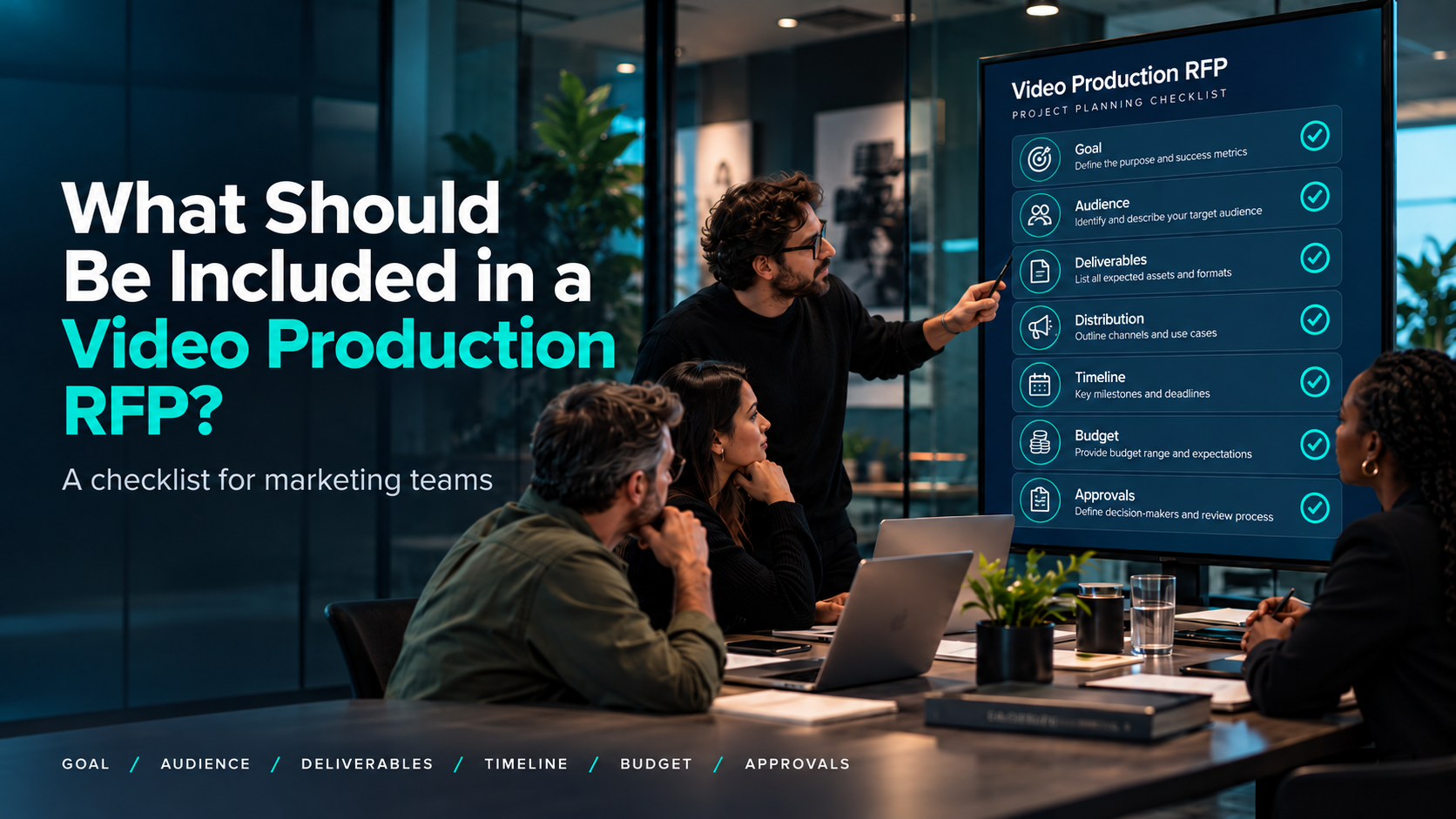
Want Better Video Proposals? Start With a Better RFP.
Marketing teams sometimes send an RFP that says: “We need a two-minute video. Please provide pricing.”
Five production companies respond.
One assumes the client already has a script.
Another includes scripting.
One assumes live action.
Another assumes animation.
One includes several deliverables.
Another includes only one.
The budgets are dramatically different.
And none of the proposals are easy to compare.
The problem may not be the vendors. They are solving different versions of the project. A useful RFP gives everyone enough context to solve the same problem.
1. Explain the Business Goal
“We need a video” is not the goal.
Maybe you need to:
- Launch a product.
- Support sales.
- Explain a platform.
- Train customers.
- Increase awareness.
- Recruit employees.
- Support a conference.
- Tell a customer story.
That context helps the studio recommend the right creative approach.
2. Define the Audience
Who is watching?
(Executives? Engineers? Consumers? Patients? Sales prospects? Employees? Procurement? Field technicians?)
A video aimed at a technical installer is very different from one aimed at executive leadership.
If several audiences exist, say so.
The studio may recommend multiple edits rather than forcing one video to serve everyone.
3. Describe the Deliverables
Include anything already known.
For example:
- One 90-second hero video.
- Three 30-second edits.
- Vertical social versions.
- Trade show loops.
- Spanish subtitles.
- Closed captions.
- Still frames.
- Multiple aspect ratios.
You do not need every detail finalized before the project begins.
But anything you already know should be included because it affects scope.
4. Explain Where the Content Will Appear
Distribution influences creative decisions.
Will the video appear on:
- Your website?
- LinkedIn?
- Paid ads?
- Trade show screens?
- YouTube?
- Sales presentations?
- Training platforms?
- Conference displays?
A silent looping booth video is not created the same way as a narrated product-page video.
5. Share Existing Assets
Tell the production company what you already have or what you will be providing.
Brand guidelines.
CAD.
Photography.
Existing footage.
Product renders.
Messaging.
Scripts.
Technical documentation.
Logos.
Previous animation.
Those assets may affect the recommended approach and budget.
6. Explain Technical or Regulatory Requirements
This is especially important for industries such as:
Energy.
Medical.
Industrial.
Infrastructure.
Healthcare.
Engineering.
Does engineering need to review the work? Legal? Regulatory?
Does the crew need PPE? Safety training? Special access? Security clearance?
Tell the vendors before they build the proposal.
7. Give a Real Timeline
Include the dates that matter.
Kickoff.
Product availability.
Internal review.
Launch.
Conference.
Trade show.
Stakeholder availability.
If the video absolutely must be complete before a major event, that should be clear.
The production partner can then determine whether the timeline is realistic.
8. Include a Budget Range When Possible
Budget helps the studio recommend realistic creative solutions. A $20,000 production and a $100,000 production may both address the same business goal. They will approach it differently.
Sharing a range helps prevent everyone from spending time on proposals that were never financially possible.
9. Explain the Approval Process
Who approves:
Messaging?
Script?
Storyboard?
Technical accuracy?
Rough cuts?
Final delivery?
One decision-maker and twelve decision-makers create very different project schedules. If marketing, engineering, legal, and leadership all need to approve the work, build that into the project from the beginning.
10. Tell Vendors How You Will Choose
What matters most?
Relevant experience?
Creative approach?
Technical capabilities?
Industry knowledge?
Price?
Timeline?
Team?
Process?
Let the studio know what the decision criteria are.
It helps them focus the proposal on the information your team actually needs.
Leave Room for Creative Recommendations
A strong RFP gives context without dictating every creative choice.
Maybe you think you need live action. The studio identifies a critical section that needs 3D.
Maybe you request one three-minute video. The studio suggests a 90-second overview plus several feature modules.
That strategic thinking is part of what you are hiring a production partner to provide.
Comparable Inputs Create Comparable Proposals
A good video RFP does not need to be 25 pages.
It needs to clearly explain:
- The problem.
- The audience.
- The deliverables.
- The constraints.
- The timeline.
- The review process.
At Control Shift Video, we respond to RFPs and creative briefs across video production, motion graphics, 3D animation, and technical storytelling.
The more we understand about the business problem, the better we can recommend the right solution.
Ready to Transform Your Video Content
Discover how Control Shift Video can elevate your brand's visual storytelling