
The Ultimate Guide to Reviewing Your Video Project
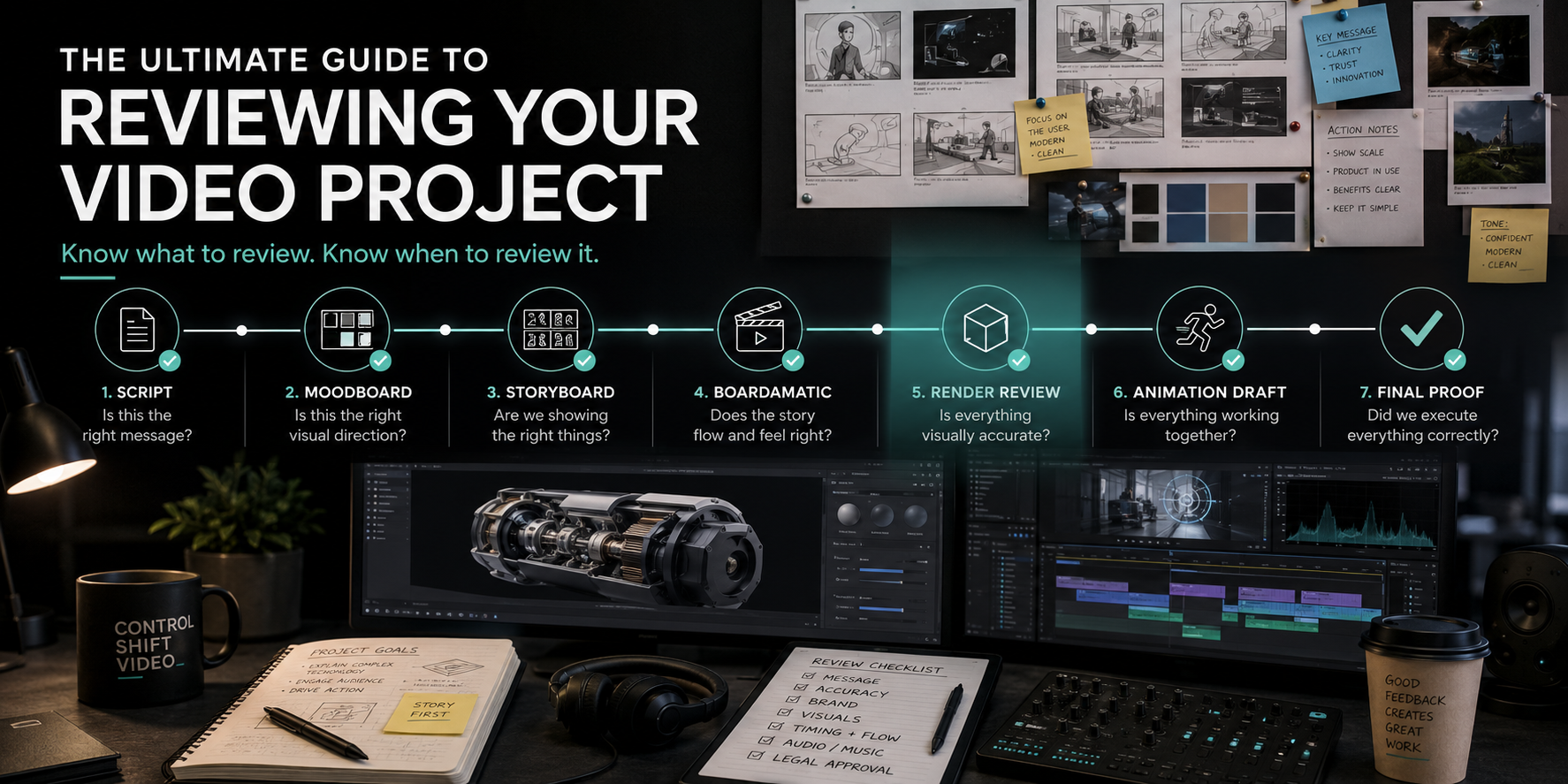
Whether you're reviewing a 2D animation, 3D animation, live-action video, or a combination of all three, knowing what to look for at each stage can save time, reduce revisions, and help your team get the best possible result.
One of the most common challenges we see isn't bad feedback—it's feedback arriving at the wrong stage.
For example:
- Approving a script, then rewriting major sections after the voiceover has been recorded.
- Approving a storyboard, then requesting a completely different visual direction after animation is complete.
- Approving product renders, then changing the product design after scenes have been animated and rendered.
- Bringing in a key stakeholder for the first time during the animation review.
Can changes be made? Usually.
But they're often more expensive, time-consuming, and disruptive than if they had been addressed earlier.
The good news? Every stage of production is designed to answer a specific question. Knowing what to review—and when—helps projects stay on schedule and produce stronger final results.
Before We Talk About Feedback: Bring the Right People In Early
One of the most expensive mistakes a team can make is waiting too long to involve key stakeholders.
We've seen projects move smoothly through scripting, storyboards, and design reviews, only to reach animation and suddenly receive feedback from someone seeing the project for the first time.
The result?
Major revisions that could have been identified weeks earlier.
Sometimes this means:
- Reworking approved messaging
- Redesigning scenes
- Re-recording voiceovers
- Rebuilding animations
- Extending timelines
- Increasing costs
A simple rule of thumb:
If someone has approval authority, they should be involved before production begins.
This may include:
✓ Marketing teams
✓ Product owners
✓ Subject matter experts
✓ Sales leaders
✓ Executive stakeholders
✓ Legal or compliance teams
✓ Regional teams or business units
The earlier stakeholders are aligned, the smoother the project will move.
Producer Secret: It's much easier to adjust a sentence in a script than it is to rebuild an animated sequence after it's been designed, animated, and rendered.
Script Review
The Question We're Answering:
Is this the right message?
The script is the foundation of everything that follows.
Focus On:
✓ Messaging
✓ Accuracy
✓ Audience relevance
✓ Technical details
✓ Brand terminology
✓ Calls to action
✓ Legal and compliance requirements
Ask Yourself:
- Is this the right message?
- Does this sound like our brand?
- Are there any factual errors?
- Are we speaking to the right audience?
- Are there any legal concerns?
- Is anything missing?
Don't Worry About:
✕ Timing
✕ Animation
✕ Music
✕ Visuals
Those things don't exist yet.
This is your best opportunity to make major messaging changes.
Producer Tip: If legal, compliance, or leadership teams will ultimately approve the project, include them during script review. Major script changes later in production create a ripple effect through storyboards, voiceover, animation, and editing.
Moodboard Review
The Question We're Answering:
Is this the right visual direction?
Moodboards establish the creative foundation for the project.
Focus On:
✓ Overall style
✓ Brand alignment
✓ Color palette
✓ Tone and feeling
✓ Reference imagery
Ask Yourself:
- Does this feel like our brand?
- Is it too playful?
- Too technical?
- Too corporate?
- Too futuristic?
- Does this match our audience?
Don't Worry About:
✕ Exact layouts
✕ Specific scenes
✕ Timing
✕ Voiceover
Moodboards are about direction—not details.
Storyboard Review
The Question We're Answering:
Are we showing the right things?
Storyboards help translate the script into visuals.
Many of our storyboards also include action notes to help explain what's happening on screen and reduce guesswork before animation begins.
Focus On:
✓ Scene concepts
✓ Visual storytelling
✓ Product representation
✓ On-screen copy
✓ Action notes
✓ Information hierarchy
Ask Yourself:
- Are we visualizing the information correctly?
- Is the story easy to follow?
- Are products or services being represented accurately?
- Are the action notes aligned with how we'd like things shown?
- Is anything missing?
Don't Worry About:
✕ Animation quality
✕ Final transitions
✕ Music
✕ Effects
At this stage we're deciding what we're showing, not how it moves.
Producer Tip: Storyboards are often the last opportunity to make significant visual changes before production ramps up.
Boardamatic Review
The Question We're Answering:
Does the story flow and feel right?
A boardamatic combines storyboards, timing, voiceover, and music direction into an early version of the final piece.
Focus On:
✓ Story flow
✓ Pacing
✓ Content order
✓ Voiceover fit
✓ Music direction
Ask Yourself:
- Does the story make sense?
- Does the pacing feel right?
- Are important messages getting enough attention?
- Does the music support the message?
- Does the overall tone feel right?
Music Selection Tips
When reviewing music options, think about how you want your audience to feel.
Ask yourself:
- Does it feel professional?
- Does it feel trustworthy?
- Does it feel innovative?
- Does it match our audience?
- Does it support the message without distracting from it?
Music can dramatically change how a video feels, even when everything else remains the same.
Don't Worry About:
✕ Final animation
✕ Lighting
✕ Render quality
✕ Effects
This is where timing and tone should be addressed before animation begins.
3D Render & Style Frame Review
The Question We're Answering:
Is everything visually accurate?
Before full animation and rendering begins, we often provide render samples or style frames for review.
Focus On:
✓ Product accuracy
✓ Materials
✓ Colors
✓ Logos
✓ Labels
✓ Environments
✓ Camera angles
Ask Yourself:
- Is this the correct product version?
- Are branding elements accurate?
- Are materials and colors correct?
- Does the environment feel right?
Don't Worry About:
✕ Final edit pacing
✕ Audio
✕ Motion graphics timing
✕ Transitions
Producer Warning
A render review is often the last practical opportunity to make major visual changes before rendering begins.
Once scenes move into animation and final rendering, revisions become significantly more time-consuming and costly.
Animation Draft Review
The Question We're Answering:
Is everything working together?
Now we're reviewing movement, clarity, and execution.
Focus On:
✓ Motion
✓ Story clarity
✓ Readability
✓ Timing
✓ Transitions
Ask Yourself:
- Is everything easy to understand?
- Does the motion feel intentional?
- Is any information difficult to read?
- Does the overall flow work?
Avoid:
✕ Major script rewrites
✕ New scenes
✕ New products
✕ New creative directions
At this stage we're refining—not rebuilding.
Final Proof Review
The Question We're Answering:
Did we execute everything correctly?
This is the final quality-control pass.
Focus On:
✓ Typos
✓ Brand compliance
✓ Legal approvals
✓ Audio quality
✓ Export quality
✓ Final accuracy
Ask Yourself:
- Is everything spelled correctly?
- Are logos accurate?
- Is the audio clean?
- Does everything match previous approvals?
Avoid:
✕ New concepts
✕ New messaging
✕ New scenes
✕ New strategy
Ideally, legal and compliance teams have already reviewed the script earlier in the process. Final proof should confirm that approved language has been implemented correctly—not serve as the first legal review.
The Real Goal of Reviews
Every review stage exists for a reason:
Script: Is this the right message?
Moodboard: Is this the right visual direction?
Storyboard: Are we showing the right things?
Boardamatic: Is the pacing, voiceover, and music working together?
Render Review: Is the product, environment, and design accurate?
Animation Draft: Is everything moving and communicating correctly?
Final Proof: Did we execute everything accurately?
The most successful projects aren't the ones with the fewest comments.
They're the ones where the right people review the right things at the right time.
That's how great work gets made.
Ready to Transform Your Video Content
Discover how Control Shift Video can elevate your brand's visual storytelling