
Planning a Product Launch Video: What Marketing Teams Should Know Before Production
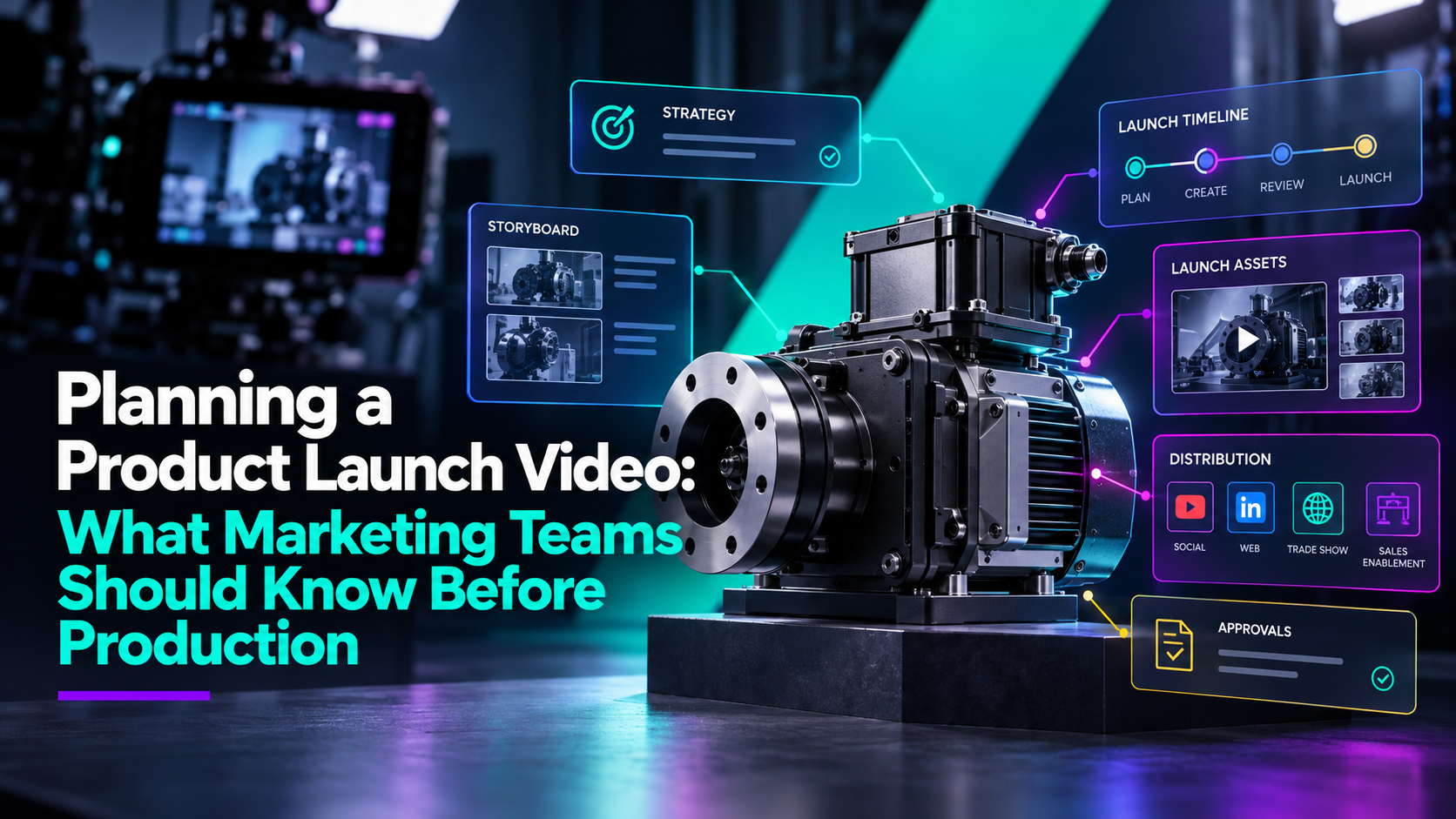
A Product Launch Video Shouldn't Be an Afterthought
The launch date is set.
The website is being updated.
Sales is preparing presentations.
The event booth is already being designed.
Someone asks:
"What are we doing for video?"
And suddenly everyone realizes the product launch video is supposed to be finished in three weeks. Sound familiar?
Video production gets much easier—and usually much more useful—when it becomes part of the launch strategy instead of a final deliverable added to a checklist.
Here's what your marketing team should decide before production begins.
1. What Is Actually New?
This sounds obvious, but it is often surprisingly difficult to answer. A product team might provide 15 new features. Your audience probably doesn't care equally about all 15. Determine what makes this launch meaningful.
Is the product:
- Faster?
- Easier to install?
- More powerful?
- Smaller?
- More integrated?
- Safer?
- More flexible?
- Solving something that couldn't be solved before?
That becomes the creative foundation. Features can support the story, but the audience needs a reason to care first.
2. Who Needs to Understand It?
A launch targeting engineers will require different information from one targeting executives.
Even within the same company, you may need to communicate with:
- End users
- Engineers
- Operations
- Procurement
- Executives
- Channel partners
- Investors
- Existing customers
- New prospects
You don't necessarily need a completely different production for every audience. You may need different edits. Planning those versions before production can save a significant amount of rework.
3. Where Will People See the Video?
A product launch video playing on a giant trade show display should not automatically be edited the same way as a LinkedIn ad.
Think through the entire distribution plan before creating the master video.
Potential placements include:
- Product pages
- Homepage
- YouTube
- Paid social
- Sales presentations
- Email campaigns
- Trade shows
- Conference screens
- Digital advertising
- Distributor websites
Each platform creates different requirements for runtime, orientation, pacing, captions, sound, and messaging. If we know those requirements early, we can design for them.
4. Do You Actually Have a Product to Film?
Physical availability matters. If the product is still being manufactured, exists only as a prototype, or cannot leave the facility, traditional production may be difficult. This is where 3D product animation can become extremely useful.
Existing CAD models may provide a starting point for photorealistic product visuals, exploded views, internal components, or complete animated sequences.
Your launch campaign can potentially move forward without waiting for a finished production model.
5. What Can't a Camera Show?
Even when the product exists, filming may not tell the entire story.
What happens inside it?
What happens underground?
What happens at the microscopic level?
What happens to data after a user presses a button?
What does the system look like across multiple locations?
These questions can help determine where motion graphics or 3D animation should complement your live footage. A strong product video doesn't simply document what the product looks like. It explains what makes it valuable.
6. How Much Content Can You Create at Once?
Think beyond the hero video.
If you're investing in production, ask what else your marketing team will need during the next several months.
A single launch production could potentially create:
- One hero launch video
- Several product feature videos
- 10–15-second social ads
- Vertical social content
- Website loops
- Sales presentation clips
- GIFs
- Still images
- Trade show content
- Customer training material
You don't necessarily have to create every asset immediately.
But filming and designing with those future uses in mind can make repurposing significantly easier.
7. Who Needs to Approve It?
Product launches tend to attract stakeholders.
Marketing.
Product.
Legal.
Leadership.
Engineering.
Sales.
Sometimes all of them.
Determine who needs to review scripts, visual concepts, storyboards, rough cuts, and final deliverables before work begins. Late-stage feedback from a stakeholder who wasn't included earlier can create expensive changes. Technical and regulated industries should be especially deliberate about subject-matter and legal reviews.
Your Launch Video Is Part of the Product Experience
A potential customer may watch your video before they speak to your team, attend a demo, or read a technical document. For a moment, the video is the product.
It establishes expectations.
It explains the problem.
It communicates the value.
And if it's doing its job, it makes viewers want to learn more.
Control Shift Video helps technology, industrial, SaaS, energy, and consumer technology teams turn new products into launch stories people can quickly understand. Your team already did the hard part: building the thing. Now people need to understand why it matters.
Ready to Transform Your Video Content
Discover how Control Shift Video can elevate your brand's visual storytelling