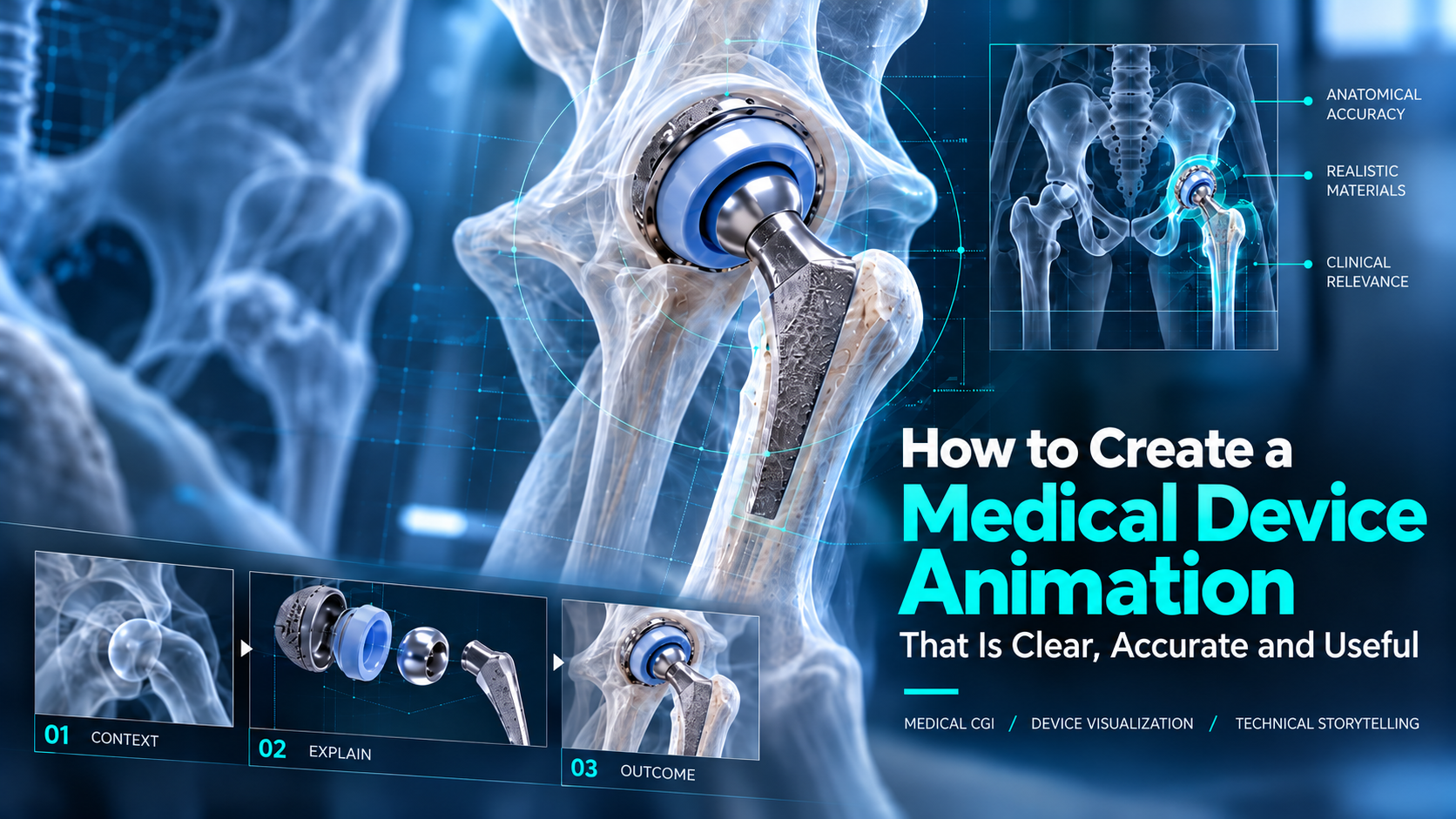
How to Create a Medical Device Animation That Is Clear, Accurate and Useful
Medical Animation Has Two Jobs
Make the concept easier to understand, and make sure it is still correct. That second requirement changes the production process significantly. Medical technology often involves complicated anatomy, specialized terminology, technical products, clinical procedures, and regulated claims. A beautiful animation that explains the procedure incorrectly is not a successful animation.
Clarity and accuracy have to work together.
Start With the Audience
A patient and a surgeon may be watching the same technology for completely different reasons.
A patient may want to know:
What happens during the procedure?
What problem is being addressed?
What should I expect?
A surgeon may care about:
Placement.
Technique.
Instrumentation.
Workflow.
Product differentiation.
A sales team may need something else entirely. Before determining the animation style, determine who needs to understand the information.
Decide What Needs to Be Realistic
Not every element needs the same level of visual detail. The medical device itself may need to be extremely accurate. The anatomy may require realistic representation. The environment may be simplified. Background structures may only exist to help orient the viewer. More detail is not automatically better. Too much information can overwhelm the audience.
The goal is the right detail in the right place.
Bring Medical Experts Into the Process Early
Subject-matter experts should not see the work for the first time at final review.
Depending on the project, reviewers may include:
Physicians.
Surgeons.
Clinical teams.
Product specialists.
Regulatory reviewers.
Legal.
Marketing.
Each group may notice different issues.
The production schedule should create deliberate approval points.
For example:
Script.
Storyboard.
Anatomy.
Device model.
Procedure sequence.
Claims.
Technical feedback becomes much easier to address when it arrives early.
Use Storyboards to Verify the Procedure
Storyboards are extremely important for medical animation.
They allow the team to confirm:
Procedure order.
Camera position.
Instrument placement.
Device orientation.
Anatomical relationships.
What the viewer is supposed to notice.
The storyboard does not need photorealistic anatomy. It needs enough information for the medical team to confirm that the visual story is correct.
Simplify Without Distorting
Medical communication often requires simplification.
The viewer does not always need to see:
Every tissue.
Every instrument.
Every person.
Every object in the room.
Every anatomical structure.
Instead, the animation can guide attention.
The product may be highlighted. Surrounding anatomy may become transparent. Unnecessary detail may fade away. Color may identify one important structure. The virtual camera can move into areas that would be impossible to film.
The goal is to remove visual noise without changing what is actually happening.
Be Careful With Claims
Medical marketing may involve strict review requirements.
Claims about:
Performance.
Outcomes.
Benefits.
Speed.
Recovery.
Clinical results may need support or approval.
The animation team should not invent stronger language simply because it sounds persuasive. Approved messaging should be incorporated early. That reduces the risk of rewriting large sections at final review.
One Medical Animation Can Support Several Uses
A well-built medical device asset may support:
Patient education.
Surgeon education.
Sales.
Product launch.
Conference screens.
Training.
Website content.
Investor presentations.
The messaging may change for each audience. The underlying device model and anatomy may still be reusable. That is worth thinking about before production begins.
Sometimes Live Action Helps
Not every medical story needs to be entirely animated.
A physician interview can add authority.
A patient story can provide emotional context.
Real product footage can establish physical scale.
A demonstration may show how the technology is actually handled.
The strongest communication may combine real people with technical visualization.
Accuracy Builds Trust
Medical technology affects real people. That raises the standard.
At Control Shift Video, healthcare and medical projects involve close collaboration with client teams and subject-matter experts so the visuals remain clear without losing technical credibility. The goal is not to make the medicine less sophisticated. It is to make the explanation easier to understand.
Ready to Transform Your Video Content
Discover how Control Shift Video can elevate your brand's visual storytelling