
Industrial Video Production: How to Explain Complex Technology Without Losing Your Audience
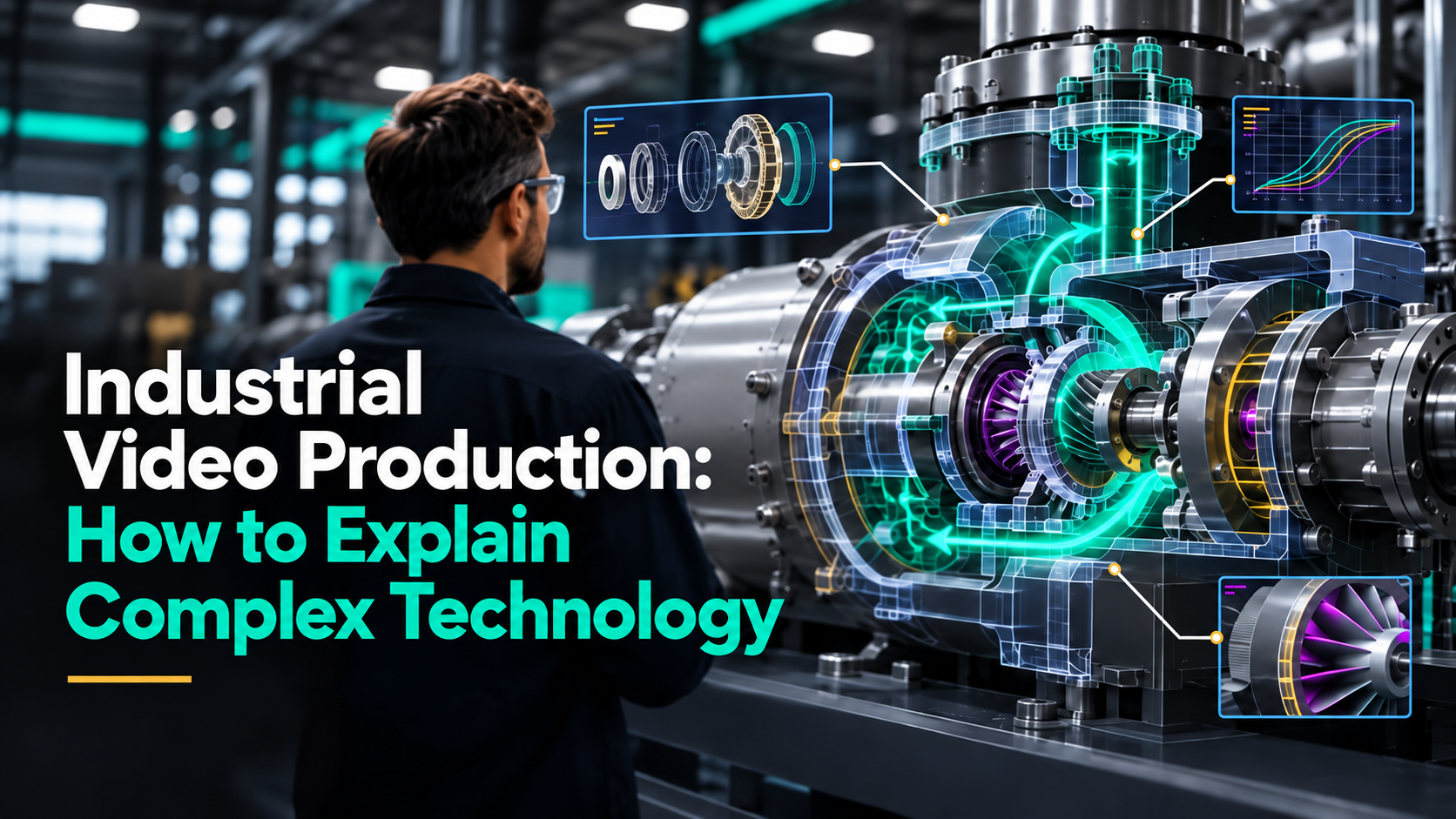
Industrial Video Production Is Different
If you've ever tried to explain a complicated piece of equipment to someone outside your industry, you already know the problem.
Your engineers understand it.
Your sales team mostly understands it.
Your customers may understand parts of it.
But translating years of engineering, technical specifications, workflows, and industry terminology into something an audience can quickly understand is another challenge entirely. That is where industrial video production becomes valuable.
Unlike a traditional brand video, industrial video often has to do more than make a company look good. It may need to explain how machinery operates, demonstrate a process, visualize something happening inside a system, train a workforce, support a sales conversation, or introduce a new technology.
The challenge is simplifying the story without simplifying the technology.
Start With What the Audience Actually Needs to Understand
One of the easiest mistakes to make is trying to explain everything. When teams spend years developing a product, every feature can feel important. That often leads to scripts packed with technical details, acronyms, specifications, and background information.
Instead, start with the audience.
Ask:
- Who is watching?
- What do they already understand?
- What problem are they trying to solve?
- What do they need to understand by the end of the video?
- What should they do next?
A procurement manager may need different information than a field technician. An investor may care about a completely different part of the system than an engineer.
The technology hasn't changed. The story has.
Show What Is Difficult to Explain
This is one of the biggest advantages of video for industrial and technical companies. Some things are simply easier to show.
A camera can document a manufacturing process.
Motion graphics can illustrate data moving between systems.
3D animation can reveal the internal components of equipment that would be impossible to see during normal operation.
Animation can also remove visual clutter and focus attention on a single component, connection, or process.
Instead of spending three paragraphs describing what happens inside a machine, you can show it happening in a few seconds.
That is particularly useful for companies working with:
- Oil and gas technology
- Energy systems
- Manufacturing equipment
- Industrial automation
- Engineering
- Medical technology
- Hardware
- Infrastructure
- Complex software connected to physical systems
Choose the Right Production Method
Not every industrial video needs the same approach.
Live Action
Live video is useful when the physical environment matters.
You may want to show your manufacturing facility, equipment operating in the field, employees working with a product, installation procedures, or customer interviews.
It adds authenticity and gives audiences a sense of scale.
Motion Graphics
Motion graphics are useful when the idea is more important than the physical object.
They can help explain workflows, software, data, processes, statistics, and abstract ideas.
3D Animation
3D becomes especially valuable when you need to show:
- Internal components
- Exploded views
- Fluid movement
- Mechanical processes
- Products that don't exist yet
- Dangerous environments
- Large equipment that is difficult to film
- Small components that are difficult to photograph
Many industrial projects use a combination of all three.
The right technique should be determined by the communication challenge—not by what looks coolest in a demo reel.
Build Accuracy Into Pre-Production
For technical industries, accuracy cannot be something you check at the end.
Subject-matter experts should be involved early.
Review scripts before storyboarding. Review storyboards before animation. Review CAD models and product details before rendering.
These checkpoints allow your technical team to catch errors while they are still inexpensive to change. Changing a sentence in a script takes minutes. Changing a fully rendered 3D sequence can take considerably longer.
A strong industrial video production process reduces uncertainty before production gets expensive.
One Video Can Support More Than One Department
Industrial video also becomes more valuable when you think beyond a single deliverable.
A core product video might become:
- A trade show video
- Website content
- Sales presentation material
- Short social clips
- Training content
- Product launch content
- Paid advertising
- Conference displays
- Internal presentations
- Customer onboarding material
Planning those uses early allows the production team to frame shots, animation, graphics, and messaging so the footage can work across multiple formats.
Instead of producing one video, you're building a library of communication assets.
Complexity Isn't the Problem. Communication Is.
Industrial products are supposed to be complex. Your audience doesn't necessarily need every technical detail. They need the right technical details presented in the right order.
Good industrial video production finds that balance.
At Control Shift Video, we work with technology, industrial, energy, SaaS, and engineering-focused teams to turn complicated products and processes into visuals people can actually understand.
Because if you've spent years developing something innovative, your audience shouldn't need an engineering degree to understand why it matters.
Ready to Transform Your Video Content
Discover how Control Shift Video can elevate your brand's visual storytelling