
How to Explain Complex Technology in Marketing Without Dumbing It Down
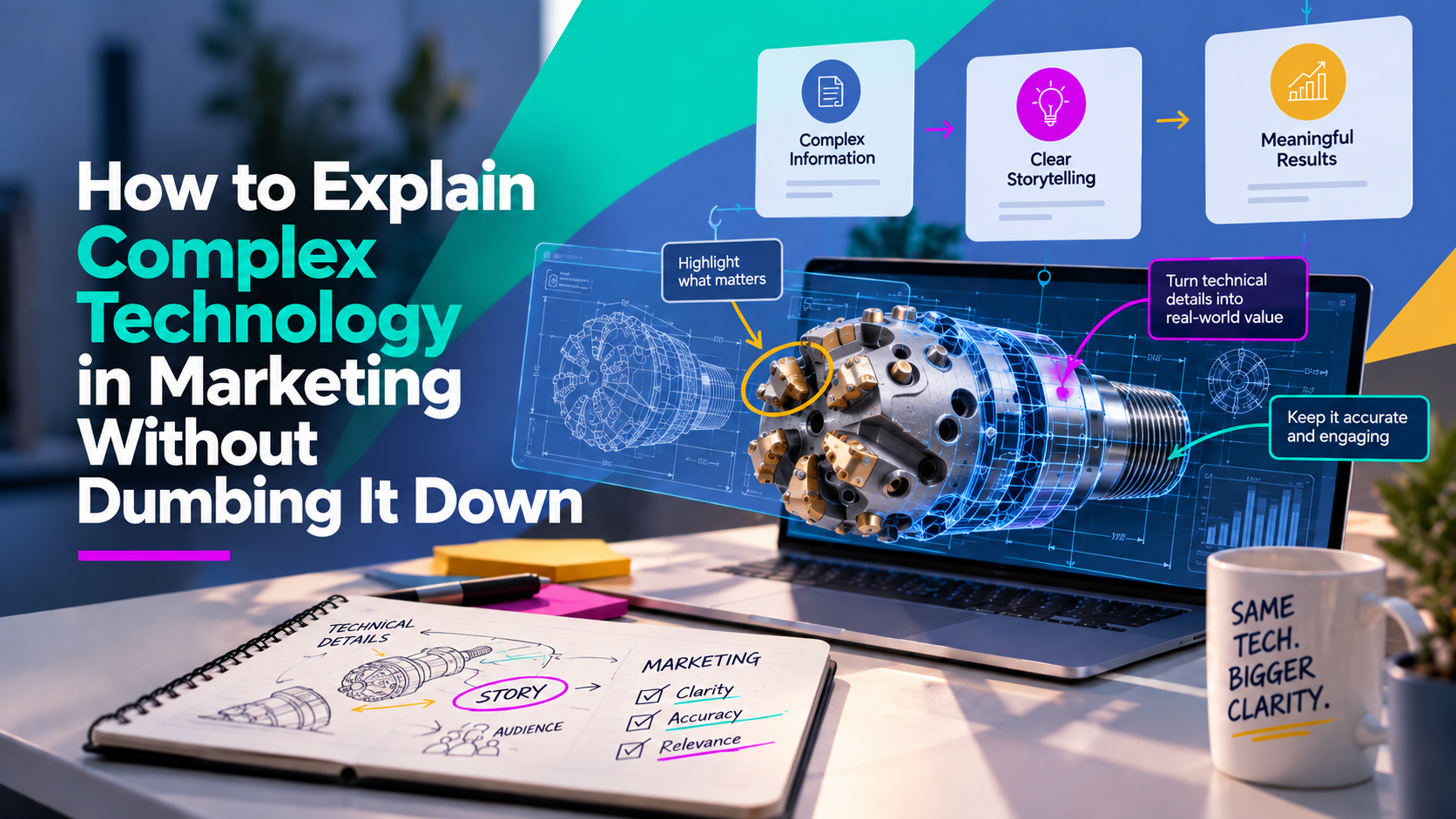
Your Technology Can Be Complicated. Your Marketing Doesn't Have to Be.
Companies developing genuinely innovative technology face a strange marketing problem. The more sophisticated the product becomes, the harder it can be to explain.
The engineering team wants accuracy.
Marketing wants clarity.
Sales wants something they can explain quickly.
Leadership wants differentiation.
Legal wants everyone to stop making claims they can't prove.
Meanwhile, your prospective customer is asking a much simpler question:
"What does this actually do for me?"
Effective technology marketing has to connect all of those perspectives. And that doesn't mean dumbing down your technology. It means structuring information so people can understand it.
Start With the Problem, Not the Product
Technical teams naturally want to explain how something works. Customers usually want to know why they should care. Imagine you're introducing a new industrial monitoring platform. You could start with:
"Our proprietary cloud-based monitoring architecture integrates real-time operational data across..."
Or you could begin with:
"When critical equipment starts failing, your team needs to know before production stops."
Now the audience has context.
You've given them a reason to care about the technology that comes next. This approach doesn't remove technical detail. It gives the detail somewhere to land.
Think in Layers
Not every audience needs the same depth of information.
A useful technology marketing strategy allows people to move deeper as their interest grows.
Layer 1: The Problem
What is happening today that shouldn't be?
Layer 2: The Solution
At a high level, what does your technology change?
Layer 3: How It Works
What process or technology makes that possible?
Layer 4: Proof
Why should the audience believe you?
Layer 5: Technical Detail
What specifications, integrations, workflows, or engineering information does a serious buyer need?
Trying to put every layer into the opening paragraph—or the first 30 seconds of a video—overwhelms people.
Give them a path instead.
Visualize Relationships
Complex technology often involves relationships that are difficult to communicate verbally. Data moves between systems. Mechanical parts interact. Sensors collect information. Software processes it. Another platform makes a decision. Equipment responds. Trying to explain that entire chain with text can quickly become exhausting.
Visual communication lets the audience see those relationships.
Motion graphics can follow information through a workflow. 3D animation can expose hidden mechanical processes. A diagram can establish an ecosystem. Live action can show how someone interacts with the technology in the real world. When audiences can see the relationship, they don't have to hold every part of the explanation in their head at once.
Remove Detail Strategically
Simplifying does not mean removing everything technical. It means removing the technical information that isn't necessary yet.
Ask of every detail:
Does the audience need this information to understand the point we're making right now?
If not, it may belong later.
Technical specifications can live on a product page. Detailed architecture may belong in a white paper. Installation instructions may belong in training. Your 60-second overview video doesn't have to carry the entire marketing department on its back.
Use Analogies Carefully
Analogies can make complicated concepts immediately understandable. They can also create technical inaccuracies. A good analogy explains the relationship between things without suggesting that the underlying technology works identically.
For example, describing a platform as a "central nervous system" might help audiences understand that information travels between different parts of an organization.
But once the analogy stops helping, leave it behind. Your visual metaphor should support the explanation—not become something your engineering team has to defend.
Bring Subject-Matter Experts Into the Process Early
One of the most effective ways to maintain technical accuracy is to include your SMEs before the creative is polished.
Have them review:
- Core messaging
- Scripts
- Diagrams
- Storyboards
- Product models
- Technical claims
But give them context for what they're reviewing. Instead of asking:
"Is this everything we should say about the product?"
Ask:
"Is this an accurate way to communicate this specific concept to someone who doesn't work in your department?"
That difference matters. Without clear direction, technical reviews tend to add information. Good communication often requires prioritizing it.
Show the Audience What They Can't Normally See
Some of the most compelling technology stories happen in places no camera can reach. Inside an engine. Across a data network. Below the earth. Inside the human body. Within a microscopic component. Across dozens of interconnected software platforms. Those are ideal opportunities for animation and visualization.
When viewers can finally see something they've only heard described, complicated ideas become intuitive.
Accuracy and Creativity Aren't Opposites
Technical companies sometimes approach creative marketing cautiously because they are concerned that simplifying the message will make it inaccurate. That concern is valid.
But the answer isn't to publish a technical manual and call it marketing. Great technology communication respects both sides. It respects the engineers who built the product enough to represent it accurately, and it respects the audience enough to make the information understandable. That's where the best technical storytelling lives.
At Control Shift Video, we create video, animation, and 3D content for companies building complicated things—from SaaS and consumer technology to industrial systems and energy.
We don't make the technology less sophisticated.
We make the story easier to understand.
Ready to Transform Your Video Content
Discover how Control Shift Video can elevate your brand's visual storytelling