How Long Should a B2B Explainer Video Be?
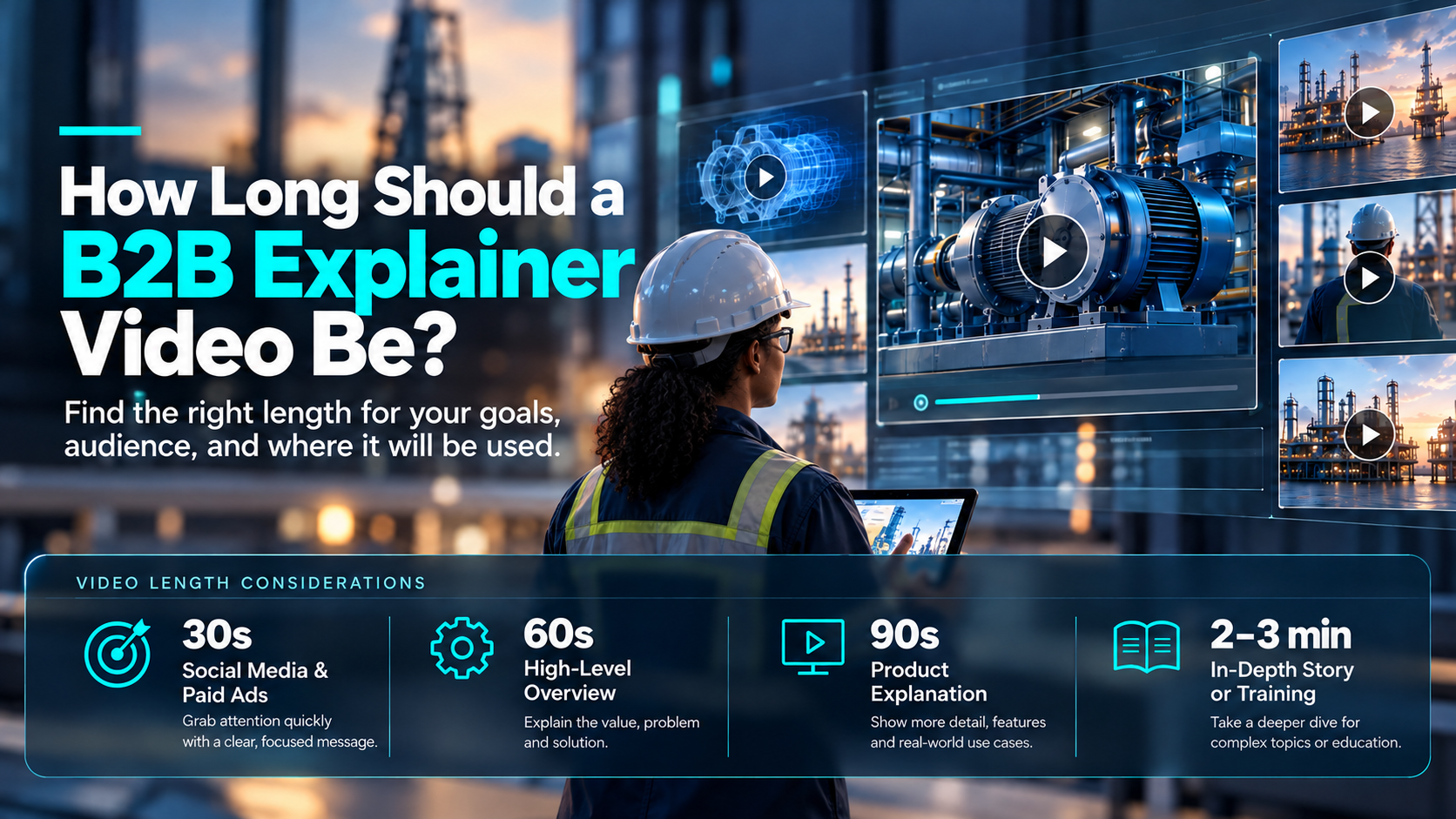
“Can We Keep It Under 60 Seconds?”
We hear this question a lot. Sometimes the answer is yes.
Sometimes the better question is:
Why does it need to be 60 seconds?
There is no universal perfect runtime for an explainer video.
Thirty seconds may be exactly right for an awareness campaign.
Ninety seconds may be better for a product overview.
Three minutes may make perfect sense when a technical buyer genuinely needs more information.
The goal is not to create the shortest possible video. The goal is to use the audience’s time well.
Start With the Job of the Video
Before choosing a runtime, decide what the video actually needs to accomplish.
Is the goal to:
- Introduce the company?
- Explain one feature?
- Launch a product?
- Help sales explain a difficult process?
- Educate customers?
- Support a trade show?
- Explain complex technology?
- Drive someone to request a demo?
Each job requires a different amount of information.
Trying to force every message into the same runtime creates unnecessary problems.
When 15–30 Seconds Works
Very short videos work best when the message is simple.
- One idea.
- One benefit.
- One visual moment.
- One call to action.
This length works well for:
- Paid media.
- Social campaigns.
- Product teasers.
- Feature highlights.
- Retargeting.
- Event promotion.
The audience should not need extensive background information.
If the viewer needs to understand a complicated workflow, 15 seconds is probably not enough.
When 45–90 Seconds Works
This is a strong range for many B2B explainer videos.
There is enough time to establish:
- The problem.
- The solution.
- A few key benefits.
- A simple explanation.
- A call to action.
For many SaaS, product, and technology companies, this is enough to create a clear overview without going too deep. But it still requires discipline. A 90-second video cannot carry the entire sales presentation.
Choose what the audience needs first.
When Two to Three Minutes Works
Longer videos make sense when the viewer is already interested and the information genuinely requires more time.
- A technical buyer may want more detail.
- A complicated industrial product may require explanation.
- A medical procedure may need additional context.
- A B2B platform may involve several stakeholders or systems.
A three-minute video is not automatically too long. A boring three-minute video is too long.
There is a difference.
Consider Where the Video Will Be Watched
A person scrolling LinkedIn behaves differently from someone watching a product video during a sales meeting.
On social media:
Attention must be earned immediately.
On a product page:
The viewer may already be actively researching.
At a trade show:
The video may need to work without sound.
During training:
The viewer expects deeper instruction.
Context matters. The viewer’s reason for watching influences how much time they are willing to give you.
Don’t Fix Length Problems by Talking Faster
If the script is too long, one tempting solution is simply speeding up the VoiceOver. That usually creates a worse video. Now the audience has the same amount of information with less time to process it.
Instead, reduce information.
Ask:
- Does this sentence add anything new?
- Does the viewer need this detail now?
- Could the website explain this?
- Could this become another video?
- Could the visual communicate this without narration?
Strong editing creates room for the audience to understand.
Maybe You Need Several Videos
Sometimes the problem is not the length. It is the scope.
Maybe the team is trying to explain:
- The company.
- The product.
- Six features.
- Three audiences.
- The implementation process.
- Customer results.
- Competitive differentiation.
All inside one video.
That may be a sign that the content should be modular. Create the 90-second overview. Then create shorter videos around individual features or audiences.
Now people can go deeper when they need to.
Let the Audience Earn More Detail
Think of communication in layers.
The first video gets attention.
The next piece adds detail.
The product page goes deeper.
The sales conversation goes deeper again.
You do not have to answer every question immediately. Sometimes creating curiosity is more valuable than providing every possible detail.
The Right Length Is Long Enough
At Control Shift Video, we do not force every project into an arbitrary runtime. We start with the audience.
- What do they need to understand?
- Where will they watch?
- What should happen next?
- Then we build the story around that job.
Sometimes that means 30 seconds. Sometimes it means three minutes.
The important thing is making sure every second earns its place.
Ready to Transform Your Video Content
Discover how Control Shift Video can elevate your brand's visual storytelling