
Houston Video Production for Tech and Industrial Companies: What to Look For
Not Every Video Production Company Needs to Solve the Same Problem
Sometimes you need a beautiful interview.
Sometimes you need someone to understand how a complicated piece of equipment works, talk to an engineer, review a CAD model, storyboard the internal process, animate it in 3D, and then turn everything into something a salesperson can explain in 60 seconds.
Those are very different production challenges.
For Houston technology, energy, industrial, healthcare, engineering, and B2B companies, finding the right production partner often means looking beyond the camera package.
The bigger question is:
Can this team understand what we’re trying to communicate?
Look for a Strong Discovery Process
A production company doesn’t need to become an engineer before working with an engineering client.
But they do need to ask good questions.
Before scripting begins, your production team should understand:
Who is watching?
What do they already know?
What problem does the product solve?
What does the audience need to understand?
What technical details absolutely cannot be shown incorrectly?
What action should the viewer take afterward?
Those answers determine the story.
Without that foundation, even beautiful production can miss the point.
Make Sure They Have More Than One Visual Tool
Not every story should be solved with a camera.
Sometimes the product exists physically and should absolutely be filmed.
Sometimes the important part happens inside it.
Sometimes you need to visualize data.
Sometimes the product isn’t manufactured yet.
Sometimes the environment is dangerous, inaccessible, or simply too expensive to film.
A production partner working with technical industries should be comfortable recommending different approaches.
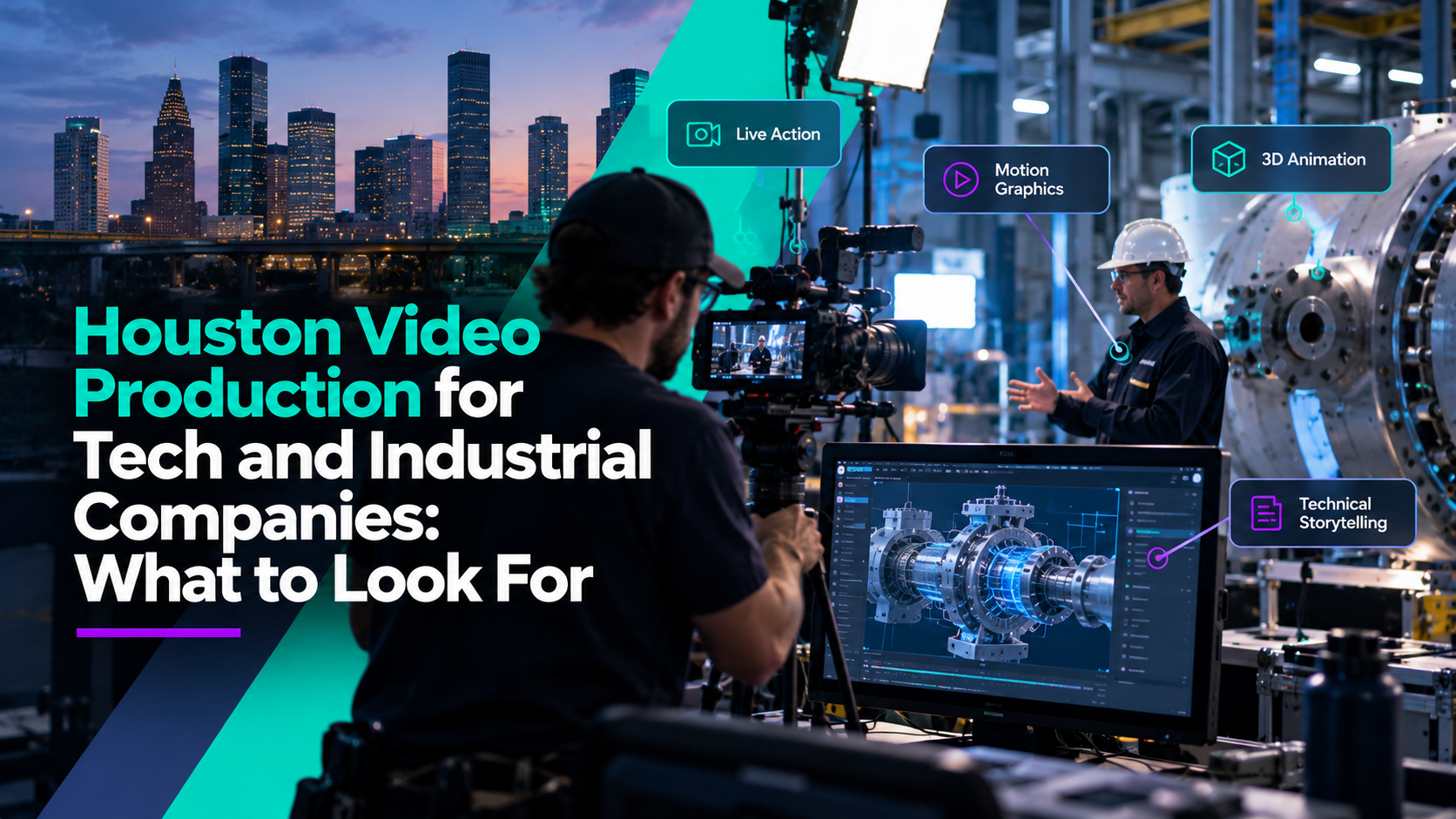
Live action.
Motion graphics.
3D animation.
Screen visualization.
Stock footage.
AI-assisted production where appropriate.
Or a combination.
The communication problem should determine the tool—not the other way around.
Ask How They Work With Engineers and SMEs
Technical stakeholders are different from typical creative reviewers.
An engineer may notice something in one storyboard frame that completely changes the animation.
A medical SME may flag terminology.
Legal may need to approve a product claim.
Operations may know that equipment would never be installed the way it appears in the concept.
Those people need to be included at the right stages.
A solid review process might include approvals for:
Messaging.
Scripts.
Visual concepts.
Storyboards.
3D models.
Animation drafts.
Final proof.
The later technical feedback arrives, the more expensive it tends to be.
Look for B2B Experience, Not Just Production Experience
B2B video has its own challenges.
The audience may be small but highly specialized.
The sales cycle may be long.
The person watching the video may not be the final decision-maker.
The content may need to help several people understand the same product from different perspectives.
That changes how messaging should be approached.
A flashy 30-second piece may look great.
But if procurement, operations, engineering, and leadership all need different information before the sale moves forward, your broader content strategy needs to account for that.
Think About Where the Video Will Be Used
Before production, your partner should know where the content is headed.
Website?
LinkedIn?
YouTube?
Trade show?
Sales deck?
Digital advertising?
Conference presentation?
Internal communications?
Training?
A hero video may be the centerpiece, but the production can often generate additional content for several of those channels.
Planning distribution before production usually creates better assets.
Local Production Still Has Advantages
Remote collaboration has made it easier to work with creative teams almost anywhere, but local production can still be extremely useful.
Houston companies may need crews to film:
Industrial facilities.
Corporate offices.
Warehouses.
Labs.
Executive interviews.
Customer sites.
Events.
Manufacturing environments.
Technology demonstrations.
Having a production team nearby can make those logistics significantly easier—especially when content needs are ongoing.
Don't Choose a Production Partner Based Only on the Reel
A great reel matters, but it only tells you what the finished work looked like. Ask about the process behind it.
Who developed the messaging?
Who interviewed the SMEs?
Who handled the storyboards?
How were technical claims verified?
How were revisions managed?
How was the content repurposed?
The process is often what determines whether the project feels organized or painful.
Choose the Team That Understands the Communication Problem
The best video production partner isn’t automatically the company with the biggest crew, largest studio, or most cinematic drone reel.
It is the team that can understand what your audience needs to know and choose the right creative tools to communicate it.
Control Shift Video is a Houston-based video studio focused on technology, industrial, SaaS, energy, and other complex B2B stories through live-action production, motion graphics, 3D animation, and technical storytelling.
We make innovation make sense.
Ready to Transform Your Video Content
Discover how Control Shift Video can elevate your brand's visual storytelling