AI Video Production for B2B Brands: Where It Helps—and Where It Doesn’t
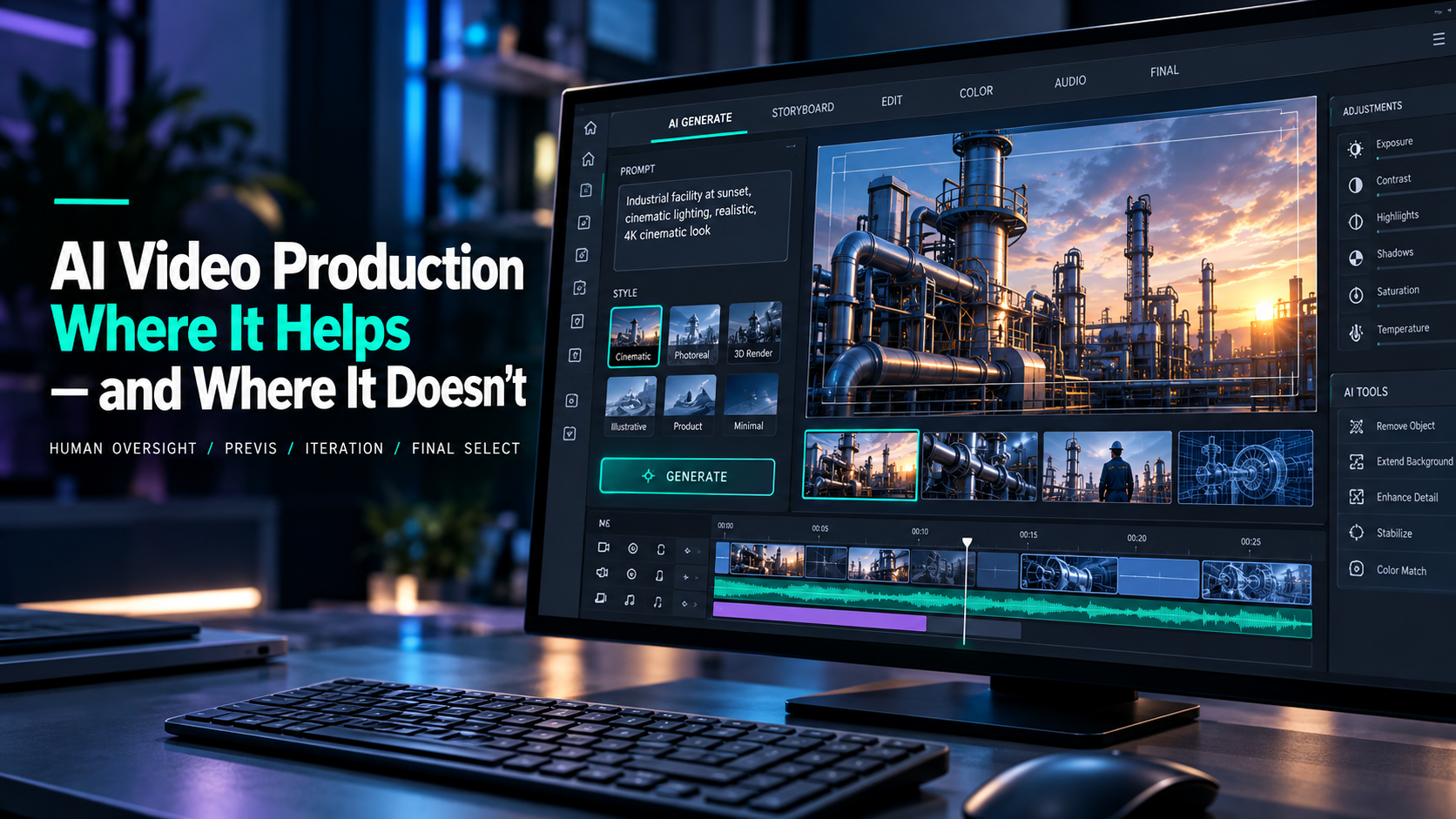
AI Video Is Not an All-or-Nothing Decision
AI video discussions tend to swing between two extremes. One side suggests AI is about to replace the entire production process. The other assumes anything created with AI is unusable. The practical reality is much less dramatic.
AI is another production tool. Sometimes it solves a problem extremely well. Sometimes a traditional camera, motion designer, or 3D animator is still the better answer. The important part is understanding where AI actually adds value.
AI Can Help With Concept Development
Creative teams spend a lot of time exploring ideas before production begins.
What should the environment feel like?
How could we visualize this concept?
What style fits the product?
Generative tools can help teams explore visual directions quickly. The generated concept does not necessarily become the final work. It may simply help the client and creative team react to an idea. Think of AI as a visual sketchbook.
AI Can Help With Previsualization
Some shots are difficult to explain verbally.
A generated reference can help communicate:
- Camera angle
- Environment
- Lighting
- Composition
- Mood
- Visual direction
The goal may still be to shoot the final scene traditionally.
AI simply helps everyone agree on what they are trying to create first.
AI Can Help With Difficult Stock Footage
Technical companies frequently struggle with stock footage. They need something very specific.
The correct industry.
The correct equipment.
The correct safety gear.
The correct environment.
Traditional stock libraries may not have it. AI-generated visuals can sometimes help fill gaps that would otherwise require an expensive custom shoot, but technical industries introduce an important risk. The image can look convincing while being completely wrong.
AI Can Help With Certain Budget Constraints
Some concepts traditionally require:
Large crews.
Travel.
Actors.
Locations.
Set builds.
Specialty equipment.
Visual effects.
AI may make selected shots possible within a smaller budget. That does not mean AI production is free.
Someone still needs to:
Develop the concept.
Generate.
Iterate.
Choose.
Edit.
Clean.
Composite.
Add sound.
Review.
AI may reduce one type of production cost while creating work somewhere else.
AI Struggles With Technical Accuracy
This is where B2B brands need to be careful.
An AI-generated industrial worker may wear incorrect PPE.
A machine may contain components that do not exist.
A medical procedure may be visually convincing but anatomically wrong.
An oil and gas operation may look realistic to a general viewer while making absolutely no sense to an engineer.
Technical marketing often requires more than visual believability. It requires accuracy. Human review matters.
AI Can Struggle With Product Consistency
Imagine marketing a specific physical product. In shot one, the connector contains six bolts. In shot two, it has eight. In shot three, the housing changes shape.
For abstract creative work, those differences may not matter. For technical product marketing, they matter a lot.
If exact product consistency is required, traditional 3D animation may provide much more control.
Real People Still Matter
Customer testimonials.
Executive interviews.
Employee stories.
Case studies.
Documentary content.
Culture.
Sometimes the power of the video comes from the fact that the person is real. AI can support the production around them. It does not automatically improve the story by replacing them. Authenticity is still valuable.
3D Animation Still Has an Important Role
If the company has accurate CAD and needs to show exactly how a product works, traditional 3D remains an excellent solution.
The production team can control:
Geometry.
Movement.
Materials.
Lighting.
Internal components.
Camera.
Technical accuracy.
AI and 3D are also not mutually exclusive. They may both be useful at different stages of the same production.
Human Oversight Is the Important Part
Instead of asking:
“Was AI used?”
A better question is:
Was the right tool used responsibly?
Someone still needs to decide:
Is it accurate?
Does it fit the brand?
Does it communicate the right idea?
Are there legal concerns?
Is the output actually good?
Should this visual even be used?
That judgment is still creative work.
Use AI When It Makes the Production Better
At Control Shift Video, we believe in a human-in-the-loop approach. AI can support brainstorming, planning, visual development, production, and specific budget challenges.
But client context, technical accuracy, editing, judgment, and final approval still require people. We are interested in new production tools. We are much more interested in using the right tool for the job.
Ready to Transform Your Video Content
Discover how Control Shift Video can elevate your brand's visual storytelling