
When Should You Use 3D Product Animation Instead of Traditional Video?
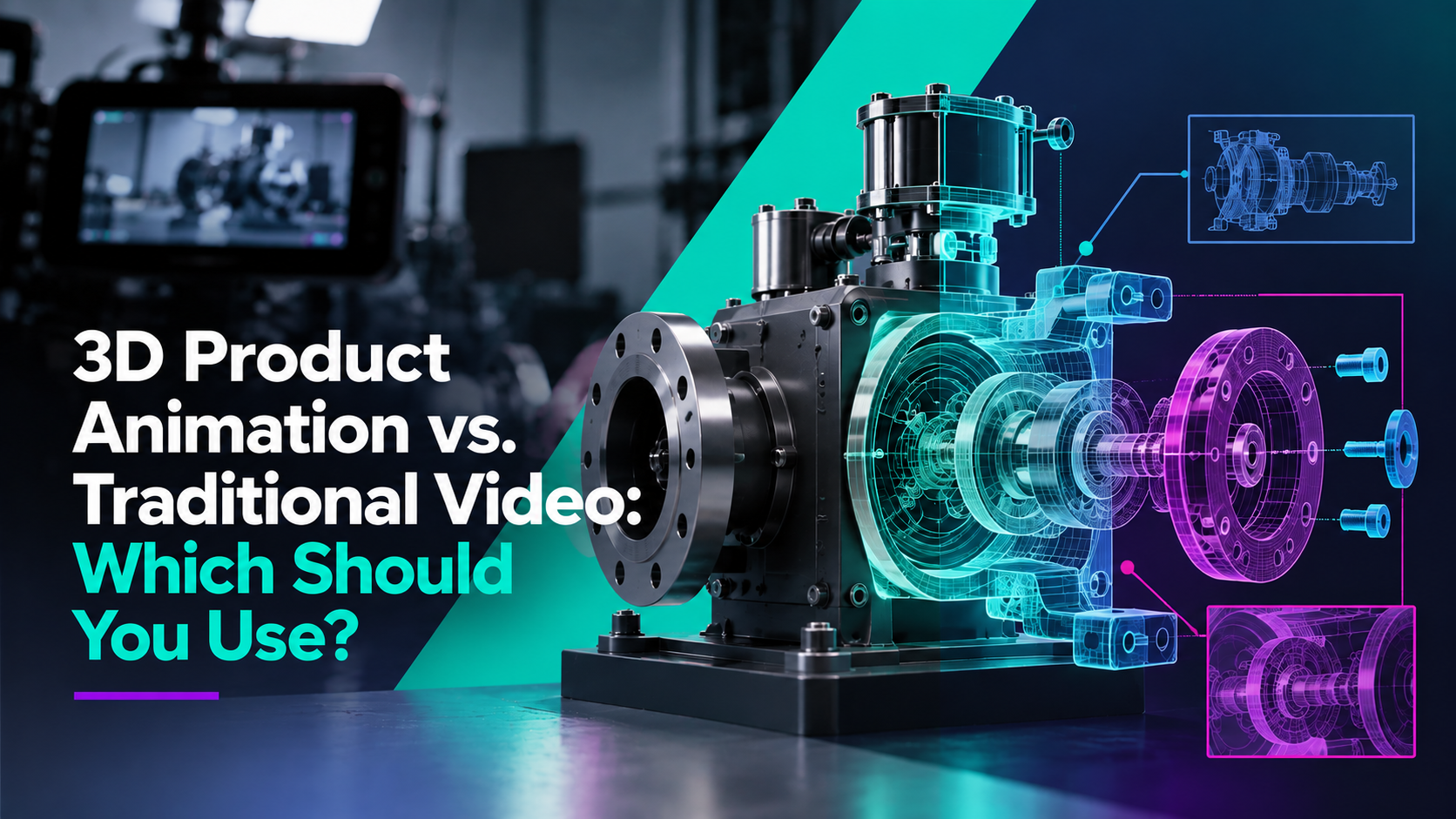
Should You Film Your Product or Animate It?
Sometimes the answer is obvious.
If you're interviewing a customer, film them.
If you're trying to show what happens inside a sealed industrial component operating thousands of feet underground, bringing a camera probably isn't going to solve the problem.
For everything in between, deciding between traditional video and 3D product animation can be more complicated.
Both can produce strong marketing content. The better choice depends on what your audience needs to see.
Use 3D Animation When the Camera Can't Show the Story
The biggest advantage of 3D product animation is freedom. A camera can only capture what physically exists and what you can safely access. A 3D environment can go almost anywhere.
You can move through a piece of machinery, separate components, make exterior surfaces transparent, follow fluid through a system, highlight a microscopic detail, or demonstrate equipment in an environment that would be difficult or expensive to film.
For technical products, that can completely change how you tell the story. Instead of explaining what's happening internally, you can show it.
Use 3D When Your Product Doesn't Exist Yet
Marketing and engineering schedules don't always cooperate.
Sometimes your sales team needs content before manufacturing is complete.
Sometimes you're preparing for a product launch while the prototype is still changing.
Sometimes the only thing available is a CAD file.
If the product design is developed enough, 3D animation can allow marketing to begin before a finished physical product is available for filming.
That can help support:
- Product announcements
- Investor presentations
- Trade shows
- Sales meetings
- Pre-launch campaigns
- Training
- Website content
It can also prevent marketing from becoming the final department waiting for a physical prototype.
Use 3D for Exploded Views and Internal Components
For physical products, one of the most useful applications of 3D is the exploded view. Individual components can separate from the product while remaining perfectly aligned, allowing the audience to see how everything fits together. This works particularly well for industrial equipment, consumer electronics, medical devices, mechanical systems, and engineered products. You can then highlight one specific component while reducing the visual emphasis of everything else.
Try doing that with a camera and a fully assembled machine.
When Traditional Video Is Better
3D isn't automatically the right answer. Sometimes audiences need to see reality.
If the goal is to show your company's people, demonstrate a real-world installation, capture a customer testimonial, document a facility, or create an emotional connection, live-action production may be significantly more effective.
Real employees and customers provide something animation can't recreate: human credibility.
Traditional video is particularly valuable for:
- Testimonials
- Company culture
- Interviews
- Facility tours
- Case studies
- Installation footage
- Documentary storytelling
- Leadership messages
Sometimes You Need Both
For many technology and industrial companies, the best solution isn't choosing one. It's combining them.
Imagine a customer describing a technical problem during an interview.
We cut from the interview to footage of the equipment.
Then we transition into 3D animation, moving through the exterior and revealing what is happening inside.
Motion graphics identify a key component.
We return to the customer explaining the result.
Each technique does what it does best.
The interview establishes trust.
Live action establishes reality.
3D establishes understanding.
Motion graphics establish clarity.
Consider the Life of the Product
Another factor is longevity.
A traditional shoot captures your product exactly as it looks that day. A 3D asset can sometimes be updated as products evolve, depending on the extent of the design changes and how the original project was built.
The same product models may also be useful for future videos, alternate camera angles, trade show displays, sales graphics, or additional animations.
That doesn't automatically make 3D less expensive, but it can increase the long-term value of the assets you're creating.
Start With the Communication Problem
The question shouldn't be:
"Should we make this in 3D?"
The better question is:
"What does the audience need to see in order to understand this product?"
Once you answer that, the production method usually becomes much clearer.
At Control Shift Video, we work with technology, industrial, energy, and product teams to determine the right combination of live action, motion graphics, and 3D animation for complex stories.
Sometimes that means putting a camera on a factory floor.
Sometimes it means flying directly through a machine.
And sometimes it means doing both.
Ready to Transform Your Video Content
Discover how Control Shift Video can elevate your brand's visual storytelling