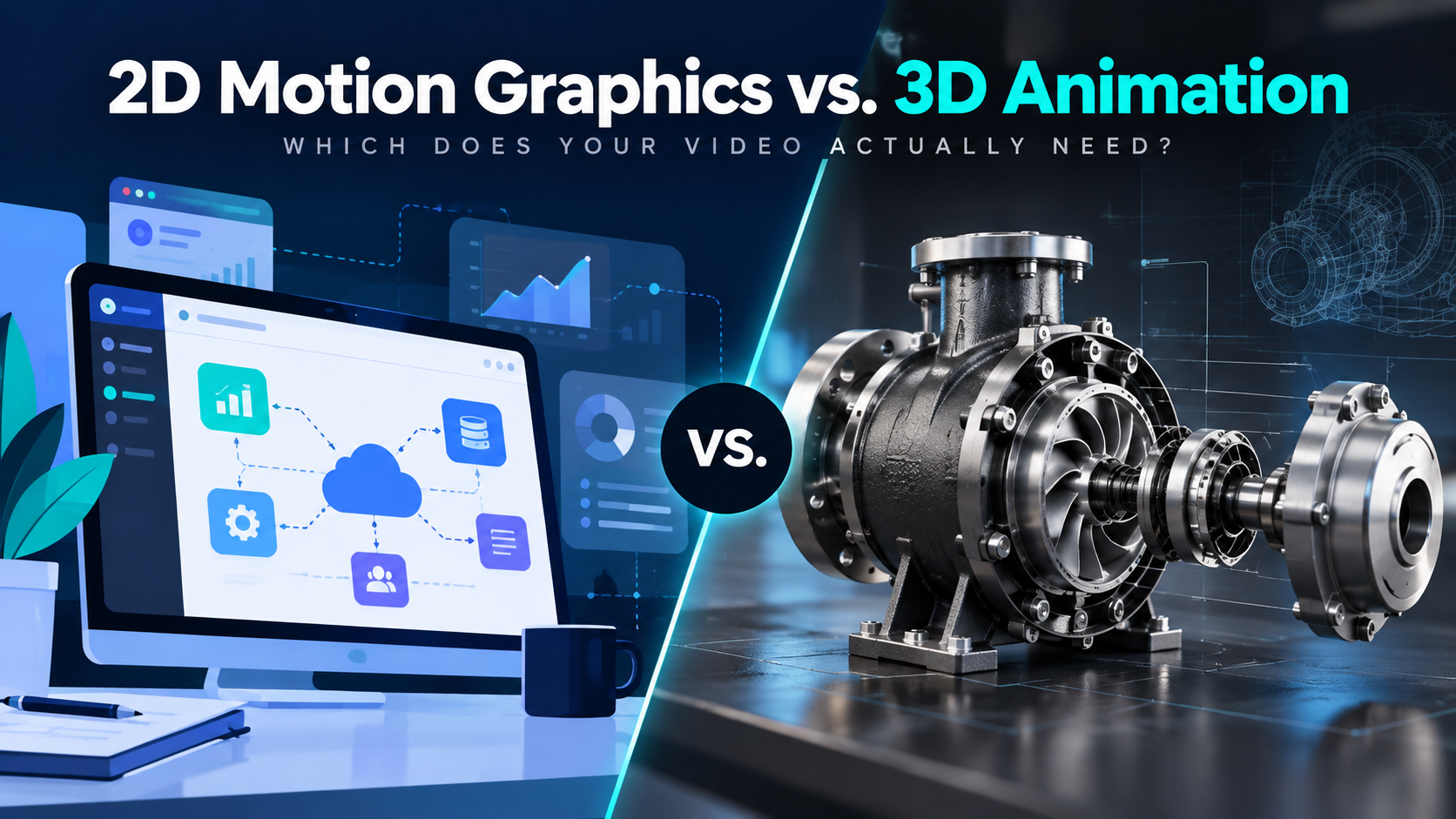
2D Motion Graphics vs. 3D Animation: Which Does Your Video Actually Need?
Does Your Video Actually Need 3D?
3D animation can be impressive.
It can reveal the inside of a machine, create photorealistic product visuals, show equipment that does not physically exist yet, and move through environments where a traditional camera could never go. But not every video needs it. Sometimes a clean 2D animation communicates an idea faster, more clearly, and more efficiently.
The question should not be:
Which one looks cooler?
It should be:
What does the audience need to understand?
When 2D Motion Graphics Work Best
2D motion graphics are especially useful when the idea is more important than the physical object.
For example:
- Data flow
- Software integrations
- Statistics
- Timelines
- Business processes
- Workflows
- Networks
- Organizational relationships
- Customer journeys
- Abstract concepts
Imagine explaining how customer information moves between several software platforms. You could build an elaborate 3D environment, but a simple animated diagram may explain the entire idea in ten seconds. 2D also gives the designer complete control over complexity. Anything that does not matter can disappear. The viewer only sees what they need at that moment.
When 3D Animation Makes More Sense
3D becomes extremely useful when physical relationships matter.
Maybe the viewer needs to see:
- How components connect
- How a mechanism moves
- What is happening inside the product
- How fluid flows through equipment
- How installation works
- How large or small something is
- How one physical product compares with another
- What a product will look like before it is manufactured
In these situations, depth is part of the explanation.
Trying to recreate a complicated mechanical system using flat graphics may actually make the information harder to understand.
What About SaaS and Software?
Software is usually a natural fit for 2D motion graphics, screen animation, or interface visualization. But even software companies sometimes benefit from 3D.
Imagine a platform that monitors industrial equipment.
The video begins with a simplified software interface.
Then the camera transitions from the dashboard into a 3D industrial environment.
Sensors collect information.
Data moves through the platform.
The dashboard responds.
Now the viewer understands both sides of the story:
The digital product and the physical system it manages.
This is why “2D or 3D?” is sometimes the wrong question. The answer may be both.
What About Industrial Technology?
Industrial videos often benefit from combining techniques. The product itself may require 3D, but the benefits may be clearer in 2D.
For example:
The animation shows a connection sequence in 3D.
Then simple motion graphics appear:
Smaller crew.
Less equipment.
Faster setup.
The 3D shows how the product works.
The 2D tells the audience why that matters.
Each format is doing what it does best.
3D Does Not Always Need to Be Photorealistic
Another misconception is that using 3D automatically means creating a highly realistic product render. Not necessarily.
3D can be simplified.
It can look technical.
Stylized.
Minimal.
Diagrammatic.
The amount of realism should depend on the communication goal and budget. Likewise, 2D motion graphics do not have to look like a generic corporate infographic. They can feel cinematic, dimensional, textured, bold, or highly branded.
The tool does not determine the creative direction.
Think About Budget and Timeline
Highly realistic 3D usually requires more production work than simple 2D motion graphics.
The model may need to be prepared.
Materials created.
Lighting developed.
Animation rendered.
That does not mean 3D is always too expensive.
It means the production effort should go toward something that actually improves the communication. If a simple diagram explains the idea perfectly, complicated 3D may be unnecessary. If the viewer truly needs to understand a physical mechanism, however, trying to save money by forcing everything into 2D may make the video less effective.
Don’t Forget Live Action
There is a third tool available:
A camera.
Some stories need real people.
Real products.
Real facilities.
Customer interviews.
Company culture.
Leadership.
Live action can establish credibility and emotion in ways animation cannot.
Many of the strongest B2B videos combine all three:
Live action.
2D motion graphics.
3D animation.
The production format follows the story.
Start With the Communication Problem
Before choosing a style, ask:
What is difficult to explain?
What needs depth?
What needs simplification?
Does the audience need to see a real person?
What cannot be filmed?
What information would be easier to show than describe?
Once those questions are answered, the right production approach usually becomes much clearer.
At Control Shift Video, we combine motion graphics, 3D animation, live action, and visual effects based on what the story actually needs. The goal is not to use the fanciest production tool. The goal is to make the complicated thing make sense.
Ready to Transform Your Video Content
Discover how Control Shift Video can elevate your brand's visual storytelling